

Independent Tech Provider Data & Comparisons




0
Based on 0 reviews
About
ZenPropTech is a prop firm technology provider that builds and configures the software stack behind a proprietary trading firm: CRM, trader and admin dashboard, risk engine, trading platform integration, KYC and payout automation, plus the marketing site and branding around it. The about page states the company was founded in 2023 and positions itself as building software for prop firms specifically rather than adapting broker tooling: "Not adapted from forex broker tools. Not built by generalist agencies."
The buyer it addresses is named directly: founders launching a first prop firm, existing brokers adding a prop vertical, trader educators and influencers monetising an audience, and firms migrating off an existing white label. Against the obvious alternative - a conventional white-label licence - ZenPropTech's stated wedge is ownership and cost structure: it says it takes no revenue share, contrasting with deals it describes as taking 10% to 30% of revenue indefinitely, and that the firm owns the resulting platform, brand and data.
Company disclosure is thin. No legal entity name, registration number, founder or executive is published anywhere on the site. The contact page gives a location of Windhoek, Namibia and hours of GMT+2, 9am to 6pm Monday to Friday, while the published Terms & Conditions state the agreement is governed by the laws of Bangladesh and the only phone number published (+8801330686418) is a Bangladesh number. The company's LinkedIn page lists an 11-50 employee band and gives a different headquarters again. Operators should establish the contracting entity and its jurisdiction on the first call.
2023
Founded
Windhoek, Namibia
Headquarters
11-50
Team size
Supported platforms
6
MT4

MT5

cTrader

Match-Trader

TradeLocker

TradingView
Product & modules
ZenPropTech sells a single end-to-end build rather than separately priced modules, but names the components consistently across its product pages. The prop firm CRM unifies trader lifecycle: onboarding, KYC status, challenge progress, account performance, payout queue and risk flags. A separate trader dashboard is the customer-facing portal for accounts, challenge progress, trade history, payout requests and certificates. Around those sit an affiliate and IB system with multi-tier commissions, revenue and cohort analytics covering funnel conversion, MRR, churn, refund rates and LTV, and email automation.
The risk engine is described in the most detail. Rules the vendor names are max daily loss, max drawdown, profit targets, minimum trading days, consistency rules, news trading restrictions, lot size limits and custom logic, configurable per program without a developer. It claims detection of copy-trading collusion, martingale and grid abuse, news and latency exploitation, and hedged-account arbitrage. Breach handling is published as a chain: "Breach detected - account locked - trader notified - CRM updated - operations alerted, all within a second", with accounts either auto-failing or routing to review at the firm's choice. Evaluation models supported are one-step, two-step, instant funding and scaling plans, run in parallel under one brand.
One material gap for a risk buyer: the site never classifies drawdown as static, trailing or end-of-day, and never says whether it is measured on equity or balance. Those definitions decide what a challenge actually costs a firm, and they are worth resolving in writing before signing.
On the back-office side, payouts are approved, batched and executed on configurable cycles with fraud detection, multi-currency support and an audit trail; KYC runs at funding and again before first payout; and certificates are generated automatically on a challenge pass.
Module
Category
Included
Prop Firm CRM
Category
CRM
Included
—
Trader Dashboard
Category
Other
Included
—
Risk Engine
Category
Risk Engine
Included
—
Challenge & Evaluation Engine
Category
Risk Engine
Included
—
Automated Payout System
Category
Payments
Included
—
Multi-Tier Affiliate System
Category
Affiliate
Included
—
KYC & Certificate Automation
Category
KYC
Included
—
Revenue & Cohort Analytics
Category
Analytics
Included
—
MT5 Dealer Plugin
Category
Trading Platform
Included
—
Services
Risk & rule engine
Configurable trader rule engine
Custom rules per programme
Real-time breach detection
Consistency rule enforcement
News-event trading filter
Aggregate exposure monitoring
Live risk dashboard
Prohibited strategies detected
Actions on breach
Back office
Payout processing
KYC / AML onboarding
Affiliate management
Multi-currency support
Payout certificate generation
KYC providers
Reporting
Platforms & terminals
ZenPropTech does not ship its own trading terminal. The trader opens a third-party platform, and the vendor supplies the branded portal, CRM and risk layer around it. The FAQ lists the supported set as MatchTrader, MetaTrader 5, MetaTrader 4, cTrader, TradeLocker and TradingView. The integrations page additionally lists NinjaTrader under Trading Platform, which the FAQ answer omits - worth confirming which is current.
MT5 gets the deepest treatment and its own page. The vendor states it connects at the MT5 Manager API level rather than through a third-party bridge, with account provisioning, trade streaming, position monitoring and rule enforcement running off that connection, plus a dealer plugin for evaluation accounts handling virtual execution and slippage simulation. It describes rules running as real-time predicates against the event stream and continuous reconciliation between MT5 server state and CRM state. MatchTrader has a comparable page describing a pre-integrated bridge with automated account creation, group setup and real-time risk sync.
Asset classes are broker-dependent. The FAQ says "forex, indices, commodities, crypto, and stocks, depending on your broker and liquidity provider", while a homepage badge reads "Multi-Asset Trading (FX, Futures, Crypto, Indices)". No broker or liquidity provider is named anywhere; the vendor says it will bridge to an existing relationship or recommend one.
No mobile app is offered or described, and no interface languages are published. The trader-facing surface is the web dashboard plus whichever terminal the firm licenses.
Terminals
Asset classes
Integrations
Integration
Category
Type
MetaTrader 5
Category
Trading Platform
Type
Native
MetaTrader 4
Category
Trading Platform
Type
Native
MatchTrader
Category
Trading Platform
Type
Native
cTrader
Category
Trading Platform
Type
Native
TradeLocker
Category
Trading Platform
Type
Native
TradingView
Category
Trading Platform
Type
Native
NinjaTrader
Category
Trading Platform
Type
Native
Stripe
Category
Payment
Type
Native
Rise
Category
Payment
Type
Native
Paytiko
Category
Payment
Type
Native
PayPal
Category
Payment
Type
Native
Google Pay
Category
Payment
Type
Native
Deployment & hosting
The delivery model is white label: the firm gets a branded platform it is told it owns, rather than a seat on a shared vendor-branded product. The homepage states the infrastructure is AWS-based, multi-region, with 99.99% uptime and sub-100ms order routing, and claims capacity for 10,000+ concurrent traders. No hosting region, data centre or co-location arrangement is named; the FAQ says only that the region "can be selected based on your trader base and compliance requirements".
MT5 hosting is published as three explicit options: ZenPropTech-hosted, where it provisions and manages the MT5 server including the white-label licence, hosting and backups (described as typically Day 4 of the 10-day build); bring your own MT5 licence, where the firm holds the MetaQuotes white-label licence and ZenPropTech integrates and manages the operational layer; and a hybrid multi-server setup running several MT5 servers across brokers, jurisdictions or account groups under one CRM.
The white-label page goes further, offering to run the platform on the firm's own domain and cloud with the firm controlling DNS, SSL and infrastructure, and offering source code access for firms wanting full technical sovereignty. What the vendor does not state is whether the standard delivery is an isolated instance and database per firm or a shared tenancy, so "dedicated" should not be assumed. Latency figures are given as marketing claims rather than measured numbers against named venues.
Deployment models
Cloud providers
Hosting
Available
Custom domain
Available
Yes
White label
Available
Yes
The homepage states 'AWS-based, multi-region deployment with 99.99% uptime'. The FAQ says hosting region 'can be selected based on your trader base and compliance requirements' but names no region or data centre. For MT5 the vendor publishes three models: ZenPropTech-hosted (it provisions the server, white-label licence, hosting and backups), bring your own MT5 white-label licence from MetaQuotes, or a hybrid multi-server setup across brokers and jurisdictions. The white-label page also offers running the platform on the firm's own domain and cloud.
Customisation & API
Branding control is the strongest documented area. The vendor lists logo, colour system, typography, domain, email templates, UI overrides and dashboard UX, and states the result is fully white-labelled under the firm's brand, domain and identity rather than a reseller arrangement. Custom development is a core service in its own right: the SaaS development page covers copy trading platforms, signal services, evaluation engines, trader analytics tools and broker-side systems built to order, and the vendor says it ships new features, runs funnel A/B tests and builds custom integrations after launch.
The API surface is asserted but not evidenced. The FAQ says "APIs for trader data, trade events, payouts, KYC status, and affiliate tracking are available for custom integrations". It does not say REST, GraphQL, WebSocket or webhooks, and no SDK or language is mentioned - so none of those is recorded as supported here. There is no public API documentation: zenproptech.com/docs and /api both return 404 (checked 19 September 2026), and no documentation link appears in the footer or navigation. No sandbox or test environment is described.
For a firm intending to build meaningfully on top of the platform, this is the section with the least to inspect before a call. The practical questions are whether documentation exists behind an NDA, what the authentication model is, whether webhooks exist for trade and breach events, and whether a non-production environment is provided during the 10-day build.
Branding control
Capability
Available
Custom development
Available
Yes
Source code access
Available
Yes
White-label depth
Available
Stated as fully white-labelled under the firm's brand, domain and identity, covering logo, colour system, typography, email templates, UI overrides and dashboard UX, with the vendor saying it is not reselling another provider's product.
The FAQ says 'APIs for trader data, trade events, payouts, KYC status, and affiliate tracking are available for custom integrations' without stating REST, GraphQL, WebSocket or webhook support, so those fields are left null. No public API documentation was found: https://zenproptech.com/docs and /api both return 404 (checked 2026-09-19). Source code access is offered on the white-label page for firms wanting 'full technical sovereignty', and the Terms state the client receives full ownership of the final work including code upon full payment.
Pricing
ZenPropTech publishes no price at all. There is no pricing page - zenproptech.com/pricing returns 404 (checked 19 September 2026) - and no figure for setup, monthly platform fee, per-account fee or any named tier appears anywhere on the site. Anyone researching prop firm white label cost will not find a number here; it comes from a quote.
The structure is described even though the amounts are not. The FAQ states: "We offer multiple models: one-time setup with monthly platform and support fees is most common. Custom enterprise arrangements are available for larger firms." Cost is said to vary by trading platform choice, custom features, integrations and ongoing support level, with a tailored quote following a free 30-minute consultation and a proposal within 48 hours. The one hard number the vendor does commit to is a 0% revenue share, stated repeatedly and positioned against white-label deals it describes as taking 10-30%.
Payment terms come from the Terms & Conditions rather than a pricing page: full payment upfront, or a 50/50 split with half before work begins and half before final delivery. A refund of up to 80% of the project fee is available if the client submits detailed feedback within 10 business days of completion, excluding work already used or implemented.
What the headline build excludes is stated plainly, which is useful: broker fees, PSP fees, KYC per-check fees, ad spend, legal and regulatory setup, and content creation beyond the launch marketing kit. To that list an operator should add the MT5 white-label licence and server costs where it is not taking the hosted option - the vendor notes firms "should account for license, server hosting, risk tooling, and ongoing operations rather than just the initial MT5 license fee" - and should establish the monthly platform fee, what a support tier costs, and the day rate for custom work, since none is public.
Commercials
Detail
Model
Detail
Custom Quote
Demo available
Detail
Yes
Custom quote only
Detail
Yes
Billing cycles
Costs on top
Implementation & onboarding
The firm is asked to supply brand assets or a brief, a preferred trading platform, a broker or liquidity provider, payment processor accounts and a domain; the vendor says it can handle most of these on the firm's behalf. It names KYC and PSP provider approval times and broker account activation as the most common causes of delay, and says these start on Day 1. Migration is described for trader accounts, historical trades, payout history and affiliate data, and for platform switches such as MT5 to MatchTrader; no incumbent vendor is named beyond 'legacy white-labels' and in-house builds. Whether migration is included in the fee is not stated.
Onboarding
Detail
Time to launch
Detail
10 days
Migration support
Detail
Yes
Migrates from
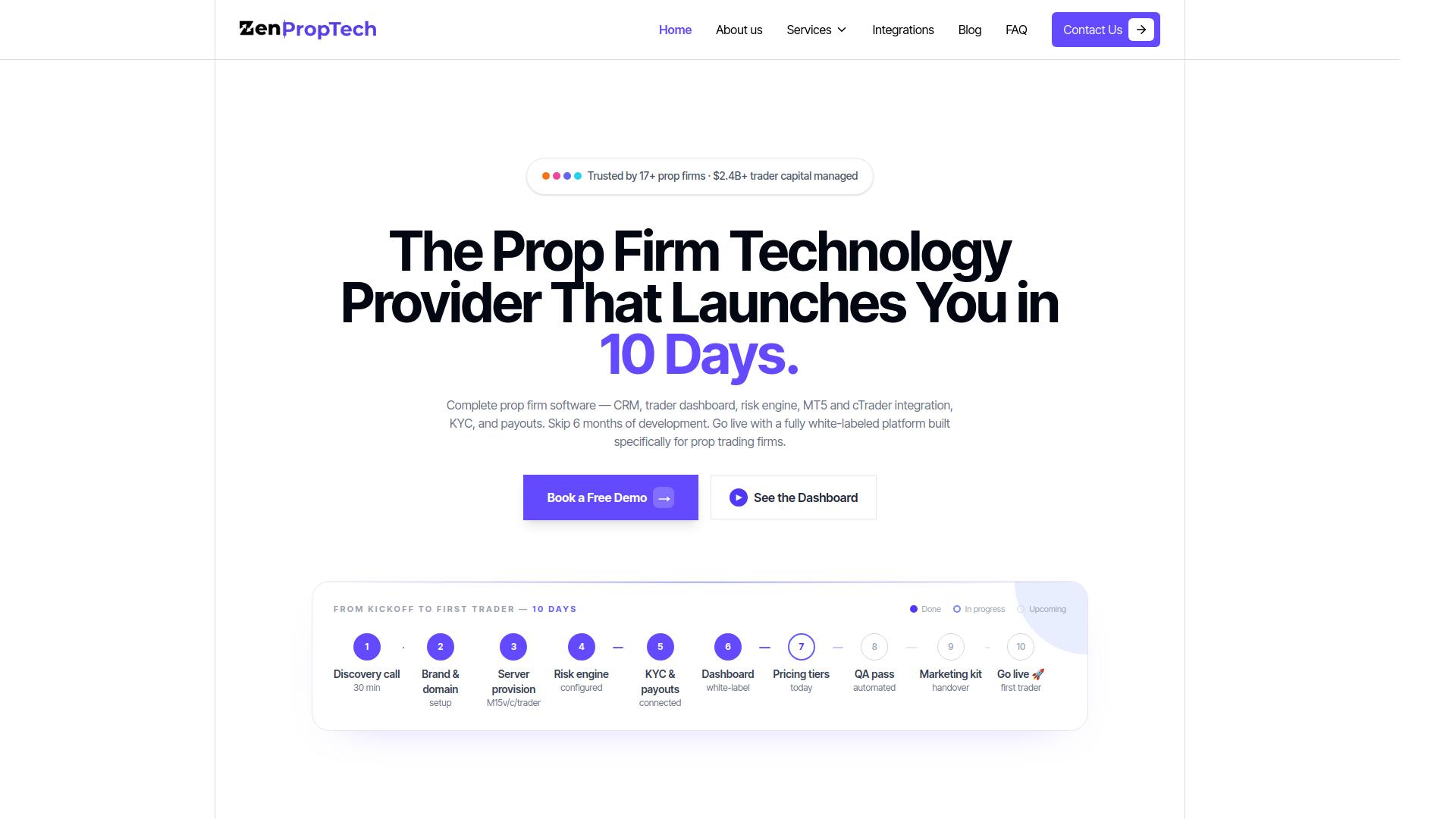
Launch steps
Discovery call
Brand and domain setup
Server provisioning
Risk engine configured
KYC and payouts connected
Dashboard white-label
Pricing tiers
QA pass
Marketing kit handover
Go live
Support, uptime & SLA
Post-launch support is described as 24/7, with a dedicated account manager and a priority Slack channel for the firm's team, covering new program launches, infrastructure scaling and feature requests. Pre-sales responsiveness is quoted as a 4-hour reply, repeated across several pages. Channels available on the site itself are a Chatway live chat widget present on every page, a WhatsApp link, email (contact@zenproptech.com) and a published phone number. The contact page separately lists office hours of "GMT+2, 9 am to 6 pm, Monday to Friday", which sits alongside the 24/7 claim without being reconciled; a buyer should establish which applies to production incidents.
On uptime, the site states 99.99% in marketing copy and describes a "99.99% uptime SLA" on the MT5 hosted option, along with sub-100ms order routing. None of this appears in the published Terms & Conditions, which contain no uptime commitment, no service credit regime and no support response obligation. The figure is therefore a stated claim rather than a contractual guarantee, and it is recorded here as such.
There is no status page and no incident history: zenproptech.com/status returns 404 and no status or uptime page is linked from the footer, FAQ or any product page (checked 19 September 2026). No post-mortems, no measured uptime and no escalation path or priority definitions are published. For an operator whose traders are affected by any outage, the absence of an observable uptime record means the 99.99% figure cannot be verified from outside, and service credits would need to be negotiated into the contract rather than assumed.
Support channels
Commitment
Detail
First response
Detail
Reply within 4 hours
Dedicated account manager
Detail
Yes
ZenPropTech states '99.99% uptime' and 'sub-100ms order routing' in marketing copy and in an MT5 hosting card ('99.99% uptime SLA'), but no contractual uptime figure, credit or measured number appears in the Terms, so uptimeGuarantee and avgLatencyMs are left empty. No status page or incident history was found: https://zenproptech.com/status returns 404 and none is linked from the footer or FAQ (checked 2026-09-19). Post-launch support is described as 24/7 with a dedicated account manager and a priority Slack channel; the contact page separately lists office hours of 'GMT+2, 9 am to 6 pm, Monday to Friday'. A Chatway chat widget and a WhatsApp link appear on every page.
Security & compliance
Security is covered by a single FAQ answer: "Encrypted data at rest and in transit, role-based access control, segregated trader funds via PSP, regular backups, and audit logging across the platform." That supports encryption at rest and in transit, role-based access control and audit logging as stated capabilities, and nothing further.
Everything else in this section is absent rather than negative, and the distinction matters. No certification of any kind is claimed - there is no SOC 2, ISO 27001 or PCI DSS mention anywhere on the site, and no trust, security or compliance page exists. No penetration testing cadence, backup frequency, RPO, RTO, disaster recovery plan, SSO, MFA or bug bounty is described. "Regular backups" is not a frequency.
On data protection, the privacy policy was last updated December 2024 and is written for website visitors rather than for a client firm's trader data: it covers names, emails, phone numbers, usage data and cookies, and states data is not sold or rented. It does not mention GDPR, a data processing agreement, subprocessors, data residency, retention periods or international transfers, and no DPA is published (zenproptech.com/dpa returns 404, checked 19 September 2026). Since the platform processes end-trader identity documents through KYC, a firm operating in the EU or UK will need a DPA, a subprocessor list and a retention position that do not currently exist in public.
The disclaimer is clear about the vendor's own role: ZenPropTech states it is a technology provider only, does not operate as a prop firm, broker, financial institution or payment processor, does not hold client funds, and makes no decisions on trader evaluations, payouts or account terminations. It also says regulatory licensing and entity setup remain the firm owner's responsibility.
Control
In place
Encryption at rest
In place
Yes
Encryption in transit
In place
Yes
Role-based access
In place
Yes
Audit logs
In place
Yes
Clients & track record
Four client names are published, as plain text chips rather than logos or links: Foxx funded, Summit strike, Mtfunded and sfx funded. They appear under "Powering prop firms worldwide" on the dashboard page and "Brands we have helped grow" on the branding page. There are no case studies, no client URLs, no start dates and no metrics attached to any of them, and no client firm's own site is cited as confirming the relationship.
Every quantitative claim is self-reported and none is broken down. The recurring figures are "Trusted by 17+ prop firms" and "$2.4B+ trader capital managed", with a stats band reading "$50M+ Client Revenue", "17+ Prop Firms Clients" and "100+ Integrations", plus "9.2d Average time to live" and "99.99% Platform uptime" on the about page.
These do not reconcile internally. The banner above the hero on the MT5, MatchTrader and challenge software pages reads "Trusted by 80+ prop firms" while the badge lower on those same pages reads "Trusted by 17+ prop firms worldwide" - the firm count is published as both 17+ and 80+ on one page. Integration counts likewise appear as 20+, 40+, "+32 more" and 100+ across different pages against a catalogue of 15 named entries. None of the figures carries a date, and there is no way to tell whether a count includes trials or completed one-off projects.
With a stated 2023 founding, roughly three years in the prop tech market, four named clients and no verifiable third-party reference, the track record available to inspect is limited. Reference calls with the four named firms are the obvious diligence step.
Named clients
Contract terms
The published Terms & Conditions read as project-based service terms, not a SaaS subscription agreement. They cover payment, refunds, revisions, IP and termination for a delivered build, which leaves the ongoing platform and support relationship - the part with a monthly fee attached - largely undocumented in public.
What is stated: payment is fully upfront, or 50/50 with half before work begins and half due on completion before final delivery. A refund of up to 80% of the project fee is available if the client submits detailed feedback within 10 business days of completion; refunds exclude work already used or implemented and any changes requested after final delivery. Either party may terminate at any time with written notice - if the client terminates early it pays for work completed to that date, and if ZenPropTech terminates it refunds work not completed. Liability is capped at the amount paid for the specific project, with no liability for indirect or consequential damages or for third-party services integrated into the build. Governing law is stated as Bangladesh, with disputes resolved under Bangladeshi law and the client's country.
On ownership the position is favourable and consistent: upon full payment the client receives full ownership of the final work including designs and code, and the FAQ states the firm owns the code, brand, domain, customer database and trade data. ZenPropTech retains a right to showcase the work in its portfolio and marketing unless otherwise agreed - worth carving out if the firm wants its vendor relationship kept quiet.
What is not disclosed: minimum term, notice period and auto-renewal for the monthly platform and support fees; SLA credits; data export formats; any post-termination data access window; and what happens to hosting, the MT5 licence and the running platform if the relationship ends. Given that the firm is told it owns the code, the practical question is whether it receives a deployable copy and the operational runbook on exit, or only the assets - and that should be written into the agreement rather than inferred.
Term
Detail
Cancellation
Detail
The Terms state either party may terminate at any time with written notice. If the client terminates before completion, the client pays for all work completed up to the termination date; if ZenPropTech terminates, it refunds the client for work not completed.
Data ownership
Detail
The firm - the FAQ states the client owns the code, brand, domain, customer database and trade data, and the Terms transfer full ownership of the final work including code upon full payment.
Liability cap
Detail
Limited to the amount paid for the specific project
Governing law
Detail
Bangladesh
The published Terms & Conditions are project-based service terms rather than a SaaS subscription agreement: they cover upfront payment or a 50/50 split (50% before work begins, 50% before final delivery), revisions, scope changes and delivery on final payment. A refund of up to 80% of the project fee is offered if the client submits detailed feedback within 10 business days of completion; refunds exclude work already used or implemented and changes after final delivery. ZenPropTech retains the right to showcase the work in its portfolio unless otherwise agreed. Governing law is stated as Bangladesh while the contact page gives a Windhoek, Namibia location. No minimum term, notice period, auto-renewal, SLA credit, data export format or offboarding window is published.
FAQs
17ZenPropTech does not publish a price and has no pricing page. The FAQ says cost varies by scope - trading platform choice, custom features, integrations and ongoing support level - and that a tailored quote follows a free 30-minute consultation, with a proposal within 48 hours. On structure it says the most common arrangement is a one-time setup fee plus monthly platform and support fees, with custom enterprise arrangements for larger firms.
No. The vendor states repeatedly that it takes no revenue share and that firms keep 100% of their profits, contrasting this with white-label deals it describes as taking 10% to 30%. Note that the no-revenue-share claim sits alongside an unpublished setup and monthly fee, so the total cost still has to be established on the call.
The published timeline is 10 days from kickoff to first trader, following a 10-step sequence: discovery call, brand and domain, server provisioning, risk engine, KYC and payouts, white-label dashboard, pricing tiers, QA, marketing handover and go-live. The about page separately cites a 9.2-day average time to live. The vendor names KYC and PSP approval times and broker account activation as the usual causes of delay.
The FAQ lists MatchTrader, MetaTrader 5, MetaTrader 4, cTrader, TradeLocker and TradingView. The integrations page additionally lists NinjaTrader under Trading Platform. For MT5 the vendor describes a native Manager API integration with a dealer plugin, rather than a third-party bridge.
Yes. The vendor states the platform is fully white-labelled under the firm's brand, domain and identity and that it is not reselling another provider's product. Branding covers logo, colour system, typography, domain, email templates, UI overrides and dashboard UX. For firms wanting more control it offers source code access and running the platform on the firm's own domain and cloud.
The integrations catalogue names 15 entries across trading platforms (MetaTrader 5, MetaTrader 4, Match Trader, cTrader, TradeLocker, TradingView, NinjaTrader), payments (Stripe, Rise, Paytiko, PayPal, Google Pay), KYC (Veriff), operations (Zapier) and growth (Brevo). Confirmo is named on the homepage. Headline counts differ across pages - 20+, 40+, 100+ - and the vendor does not publish the full list behind them.
Both are in-product rather than separate vendors for the operator to contract. Payouts run on configurable cycles - on-demand, biweekly or monthly - are validated against the firm's rules and are then triggered through the connected PSP, with fraud detection, multi-currency support and an audit trail. KYC uses Veriff, running at funding and again before first payout, with certificates auto-generated on challenge pass.
The vendor names max daily loss, max drawdown, profit targets, minimum trading days, consistency rules, news trading restrictions, lot size limits and custom logic, all configurable per program. It does not publish whether drawdown is static, trailing or end-of-day, or whether it is measured on equity or balance - worth pinning down on a call. Breaches are described as locking the account, notifying the trader and alerting operations within a second.
The FAQ states the firm owns the code, brand, customer database and trade data, and the Terms transfer full ownership of the final work including code on full payment. Beyond that, no offboarding window, export format or exit-support commitment is published, and the Terms are project-based rather than a subscription agreement, so the mechanics of leaving an ongoing support arrangement are not documented.
Marketing copy states 99.99% uptime and sub-100ms order routing, and an MT5 hosting card refers to a 99.99% uptime SLA. No contractual uptime figure or service credit appears in the published Terms, and there is no status page or incident history (zenproptech.com/status returns 404, checked 19 September 2026), so the figure is a stated claim rather than a verifiable or backed commitment.
Yes, ZenPropTech supports MT4, MT5, cTrader, Match-Trader, TradeLocker, TradingView.
Yes, ZenPropTech offers white-label deployment, letting you launch a fully branded prop firm on their infrastructure.
ZenPropTech is headquartered in Namibia.
ZenPropTech was founded in 2023.
ZenPropTech provides CRM, Risk engine, Back office, Payments, KYC, Analytics, Affiliate management, Broker bridge.
ZenPropTech supports the following business models: White label, Managed service.
Typical implementation time with ZenPropTech is 10 days.
Stay Ahead in Prop Firm Tech
Compare verified providers, track new integrations, and get vendor pricing updates as they land.
Resources
All information provided on this site is intended solely for educational and informational purposes related to prop firm technology and does not serve in any way as a specific procurement recommendation, business recommendation, investment opportunity analysis, or similar general recommendation.
Prop Tech Pal provides comparison, review, and educational resources only. We do not operate as a proprietary trading firm, technology vendor, broker, or custodian, do not offer simulated trading accounts or evaluations, and do not provide execution or custody of funds.
The information on this site is not directed at residents in any country or jurisdiction where such distribution or use would be contrary to local laws or regulations.
Prop Tech Pal does not act as a broker and does not accept any deposits.
Data, tools, and third-party references on this site are provided for informational purposes; availability and accuracy may depend on third-party sources outside our control.
© 2026 Prop Tech Pal. All rights reserved.